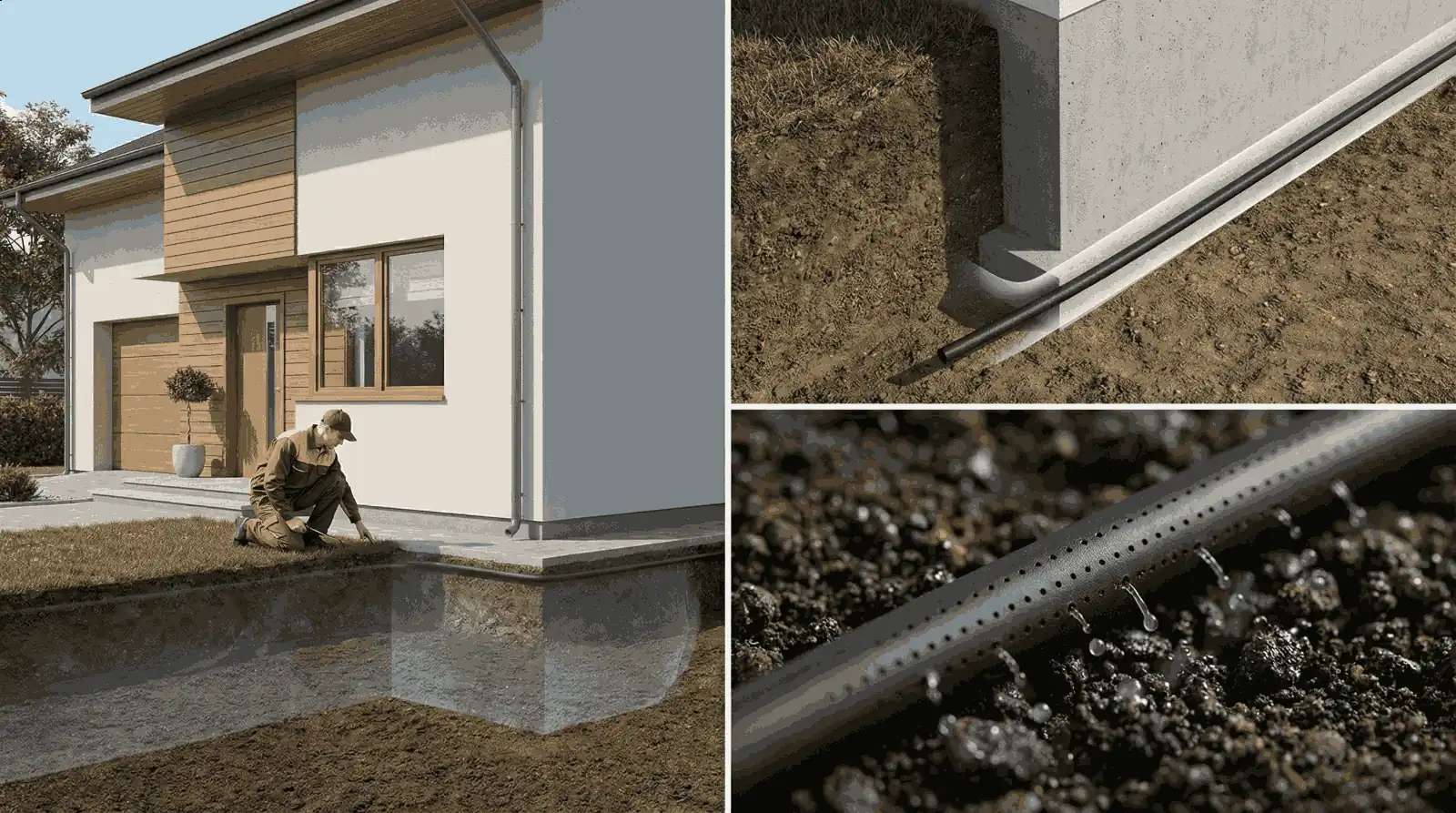
Porous Tube Anti-Termite System
A refillable pipe network in the soil around your building, so the termite barrier can be topped up without drilling your floors. For new and existing buildings across Andhra Pradesh.
What Is a Porous Tube Anti-Termite System?
Subterranean termites live in the soil and reach a building from below. They climb through cracks in the floor, gaps along the wall-floor joint, expansion joints and the openings around pipes and cables. The usual defence is a band of treated soil that termites cannot cross. The problem is that this barrier does not last forever, and topping it up in an occupied building normally means drilling holes through the floor all over again.
A porous tube system solves that problem. Perforated or porous pipes are laid in the soil along the foundation, and their ends are brought up to small charging points that stay accessible. When a termiticide solution is pumped in at a charging point, it seeps out along the full length of the pipe and wets the soil around it. The result is a continuous treated zone around the building, and it can be re-charged later from the same points without breaking a single tile.
Termites are a year-round risk in Andhra Pradesh. Warm weather, a long monsoon and moist soil in the delta and coastal districts suit them well, and homes, apartments, schools, hospitals and godowns all see damage to door frames, cupboards, furniture and stored paper. A system that can be refilled without disturbing the people inside is especially useful in buildings like these.
How the Reticulation System Works
The porous tube system is also called a reticulation system, because the pipes form a network (a "reticule") in the soil. A typical installation follows these steps:
- Site inspection and layout. We study the plan of the building, the type of soil, the drainage and any signs of termite activity nearby, and mark where the pipes and charging points will go.
- Laying the pipes. The porous pipes are placed in the soil along the foundation and, in new construction, in the areas that will sit under the floor slab. Joints and bends are fixed so that the solution reaches every run.
- Charging points. The pipe ends are brought to inlet points at the edge of the building, where they can be reached later without entering the rooms.
- First charge. A measured quantity of termiticide solution is pumped into the network so the soil around the pipes is treated along their full length.
- Records and handover. We note the layout and the position of the charging points so that future re-charging visits can find every line.
Because the pipes stay in the ground, the barrier can be renewed whenever an inspection shows it is needed, without repeating the disruptive part of the job.
Pre-Construction Fitting for New Buildings
The best time to fit a porous tube system is while the building is going up. The pipes are laid after the foundation and plinth work is done and before the floor bed is concreted, so they can run under the floor area as well as along the outer walls. Once the slab is cast, those areas can no longer be reached without breaking the floor.
If you are building a house, an apartment block or a commercial building in Andhra Pradesh, call us when the foundation is being planned. It helps if you can share:
- the building plan, or a sketch of the ground floor;
- the construction schedule, especially the date planned for the floor bed concrete;
- the name and number of your builder or site engineer, so we can coordinate on site.
Many owners also ask for soil treatment of the foundation pits and plinth fill at the same stage. We can plan both together so the work fits into your builder's schedule without delays.
Porous Tube System for Existing Buildings
A finished building can also get a porous tube system, with one difference: the floors inside are already laid. In an existing building the pipes are usually placed in a shallow trench along the outside of the walls, the trench is closed again, and the charging points are left at the edge. This protects the outer perimeter, which is where most termites enter from the surrounding soil.
Inside the building, termites can still come up through the floor itself. Where there is active infestation inside, or where the rooms need a barrier from within, we combine the perimeter system with drill-fill-seal termite treatment along the inner wall-floor joints. After our inspection we will explain which parts of your building need which method, so you pay only for what the building needs.
Re-Charging the System
Over time the termiticide in the soil breaks down, and the barrier needs to be renewed. With a porous tube system, re-charging is a short, clean visit:
- our technician inspects the building for fresh mud tubes, damaged wood and other signs of termites;
- the charging points are opened and the solution is pumped into each line;
- the points are closed again, and the visit is recorded for the next inspection.
No floors are drilled, no furniture has to be moved, and the family or staff can usually carry on as normal. How often a building needs re-charging depends on the chemical used, the soil and the termite pressure around it, so we recommend a schedule after inspecting the site. Re-charging visits can also be combined with a pest control AMC for regular inspections.
Ask us about the warranty and re-charging terms for your building when we inspect it.
Porous Tube System vs Drill-Fill-Seal Treatment
Both methods put a termiticide barrier between the soil and the building. The difference is in how the barrier is placed and how it is renewed.
| Porous tube (reticulation) system | Drill-fill-seal treatment | |
|---|---|---|
| Best suited for | New buildings during construction; existing buildings along the outer walls | Existing buildings, especially with active termites inside |
| How the chemical is placed | Pumped through pipes laid in the soil | Injected through holes drilled at the wall-floor joint, then sealed |
| Re-treatment | Re-charged through the same points, no drilling | Holes have to be drilled again |
| Disruption at re-treatment | Low; work happens at the charging points | Higher; furniture moved and floors drilled room by room |
| First-time cost | Higher, because pipes and fittings are installed | Lower for a one-time treatment |
| Price | Call for a quote after inspection | Call for a quote after inspection |
For many existing homes the most practical answer is both: a perimeter porous tube system outside and drill-fill-seal inside where termites are already active.
Porous Tube System: Common Questions
Can a porous tube system be fitted in an existing house?
Yes. In an existing building the pipes are usually laid in a shallow trench along the outside of the walls. Floors inside the house are not dug up, so rooms that need protection from inside are normally treated by drill-fill-seal as well. We decide the right mix after inspecting the building.
Do you need to drill my floor tiles?
Not for re-charging. Once the pipes are in the ground, the termiticide is pumped in through the charging points, so the barrier can be topped up without drilling. Drilling is only needed where we combine the system with drill-fill-seal treatment inside an existing building.
When should the porous tube system be laid in a new building?
During construction, after the foundation and plinth work and before the floor bed is concreted. Talk to us when the foundation is being planned so the pipe layout can be fitted into your builder's schedule.
How often does the system need to be re-charged?
It depends on the termiticide used, the soil and the termite pressure around the building. We check the site and recommend a re-charging schedule for your building rather than a fixed rule for every house.
Is a porous tube system better than drill-fill-seal treatment?
They do different jobs. Drill-fill-seal is the quickest way to treat an existing building with active termites. A porous tube system costs more to install but makes later re-treatment easier and cleaner, which is why it is most useful in new buildings and in homes with expensive flooring.
Which cities in Andhra Pradesh do you cover?
We work across Andhra Pradesh, including Vijayawada, Guntur, Visakhapatnam, Rajahmundry, Kakinada, Eluru, Machilipatnam, Tenali, Vizianagaram, Tanuku, Srikakulam and Kurnool. Call us to check the schedule for your area.
Planning a New Building or Fighting Termites?
Book a site inspection. We will check the building and explain whether a porous tube system, drill-fill-seal or both will work best.
Request a Call Back
Tell us your name, number and city. Our team will call you back to understand the problem and fix a convenient time for an inspection.